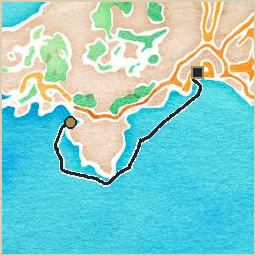
port de cabrera - cala santanyí / cala llombards

Logbook

  • Departure: Port de Cabrera (39.1495, 2.9305), Friday, May 23, 2025 at 12:23 UTC
  • Arrival: Cala Santanyí / Cala Llombards (39.3287, 3.1475), Friday, May 23, 2025 at 19:09 UTC
  • Duration: 6.8 h
  • Distance: 16.7 nm
  • Average speed: 2.5 kn
  • Crew: Tobi, Anna, Jo, Eli, Hendrik

Slipped the lines at Port de Cabrera and pointed the bow toward Cala Santanyí / Cala Llombards, a modest half-day’s sail covering 17 nautical miles at an average of 2.5 knots. Wind 2–8 kn from the WSW, gusting to 15 kn. It backed from NE to W. Seas up to 0.6m. Wind and waves were not exactly friendly. Anchoring in Cala Santanyí was interesting, wedged between two steep cliffs about 60 meters apart. Hendrik left the boat here, and we moved on to Cala Llombards, where we spent an afternoon exploring caves by dinghy.
Watercolor-style map of the route from Port de Cabrera to Cala Santanyí / Cala Llombards: a navy track line with a gold circle marking the start and a dark square marking the end

palma de mallorca - port de cabrera

Logbook

  • Departure: Palma de Mallorca (39.5607, 2.6320), Wednesday, May 21, 2025 at 09:15 UTC
  • Arrival: Port de Cabrera (39.1473, 2.9325), Wednesday, May 21, 2025 at 19:31 UTC
  • Duration: 10.3 h
  • Distance: 34.7 nm
  • Average speed: 3.4 kn
  • Crew: Tobi, Anna, Jo, Eli, Hendrik

Set a course from Palma de Mallorca to Port de Cabrera: a full day underway, 35 nautical miles at an average of 3.4 knots. Needed a cruising permit before setting off, plus a paid reservation for a mooring buoy in the natural harbor. Cabrera is the main island of the Illes de Cabrera, a nature reserve with a checkered history. Spent a couple of beach days there; Hendrik went ashore at night to photograph the Milky Way.

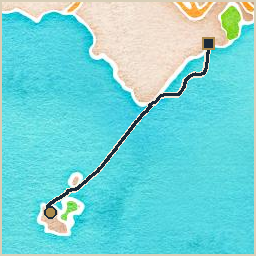
Watercolor-style map of the route from Palma de Mallorca to Port de Cabrera: a navy track line with a gold circle marking the start and a dark square marking the end

on checkered history, and needing a permit to anchor

Cabrera wanted a cruising permit and a paid mooring reservation before it would have us, which amused me more than it should have, given the island’s own history includes rather less orderly chapters: a military garrison, a notorious prison camp, centuries of being fought over by people who never once filled out a form about it first. Now it is a nature reserve, and the only thing being fought over is a mooring buoy, and you need paperwork to lose that fight too. I suppose that is what passes for progress.

The night skies here are the clearest this crew has seen all season, clear enough that Hendrik went ashore after dark with a camera to photograph the Milky Way, and I will say the island earns its reputation on that count if nothing else. A place with a history this checkered ought to at least have the decency to look peaceful once the sun goes down, and it does.

I spent the evening on deck, unseen, doing the thing I am actually built for: keeping half an eye on the boat while everyone else looked up instead of down. Somebody has to.

on retirement, and rapid unscheduled self-disassembly

Hendrik came aboard today, ferried out to the boat by dinghy, which would be an unremarkable way to start a story except that the dinghy in question chose that same window of time to finish falling apart. The logbook is calling it a state of rapid unscheduled self-disassembly. I call it a dinghy with poor timing and worse judgment about when to make a scene.

There was no replacement waiting, of course. That is not how any of this works, whatever the crew likes to pretend after the fact. A dinghy falls apart, and only then does anyone start looking for a new one. A guest berth in Palma meant nobody needed to swim for it in the meantime, at least, but the next anchorages down the coast would not be so accommodating, so the search still happened in something of a hurry. A new, used dinghy came aboard within a few days.

The old one did not go wherever old dinghies go. Nobody could quite bring themselves to leave it on a foreign dock, so it got wrapped into a sorry sort of bundle and lashed to the stern pushpit, where, as far as I know, it is riding still, all the way back to La Ràpita and however much further this crew intends to drag it. I find I approve. A proper burial is one thing. Hauling the deceased along for the rest of the voyage rather than admit defeat is, historically speaking, exactly the kind of stubbornness a ship’s spirit respects.

santa ponça - palma de mallorca

Logbook

  • Departure: Santa Ponça (39.5142, 2.4647), Monday, May 19, 2025 at 09:18 UTC
  • Arrival: Palma de Mallorca (39.5674, 2.6379), Monday, May 19, 2025 at 15:58 UTC
  • Duration: 6.7 h
  • Distance: 17.3 nm
  • Average speed: 2.6 kn
  • Crew: Tobi, Anna, Jo, Eli, Hendrik

Cast off from Santa Ponça bound for Palma de Mallorca: a modest half-day’s sail, 17 nautical miles at an average of 2.6 knots. Wind 1–9 kn from the S, gusting to 27 kn. It veered from ESE to SW. Hendrik joined the crew in Santa Ponça for this leg, picked up by dinghy, before we sailed around the western tip of Mallorca and into the bay of Palma. Landed a guest berth at the Real Club Náutico de Palma, reasonably priced, and the facilities were great. Our old dinghy chose today to enter a state of rapid unscheduled self-disassembly, so we picked up a new (used) one here; the old one got wrapped up and lashed to the stern pushpit rather than left behind, and rode along with us the rest of the way home.

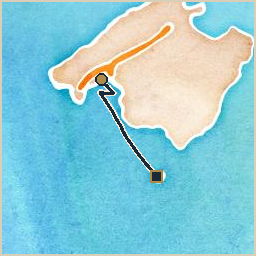
Watercolor-style map of the route from Santa Ponça to Palma de Mallorca: a navy track line with a gold circle marking the start and a dark square marking the end